
The environmental issue in the historical discipline
Carolina Piazzi, CONICET, UNL
2025

“How the tiger preys on fish”
Florian Paucke Hacia acá y hacia allá, Santa Fe,
Ministerio de Innovación y Cultura, 2010, p. 55.
Even before the emergence of Environmental History as a historiographical field, historians had been concerned with nature or the environment as an object of study, mainly inspired by geographers, as in the case of the French school of human geography. Undoubtedly, the production of the Annales, in its various generations, also contributed through its work on the history of agriculture, even if it was not framed in terms of Environmental History. Towards the 1990s there was a certain tendency to speak of “Eco history”: Peter Burke in New Perspectives on Historical Writing (1993) predicted an expansion of “Environmental History” or “Eco history”. In those years, Josef Fontana warned against the pretensions of originality that an incipient Environmental History sought to demonstrate in contrast to long-standing historiographical traditions, such as those in France, England and North America, which had been concerned with the relationship between the natural environment and human beings.
The term “environment” is a broad concept that encompasses various aspects of the natural and human-made world. It is widely accepted that human life and society are shaped by the dynamic interplay of physical, biological, and socio-cultural factors within the environment. Enrique Leff elucidates that, despite its provenance in the natural sciences, the term was conceptualized and employed as a subject of study in other disciplines as a consequence of social movements and research initiated during the 1950s and 1960s.
These movements and research endeavours sounded the alarm about the grave consequences of human actions on the planet. By the 1970s, these warnings had become a matter of state concern and were placed on the international public agenda. Adopting this perspective reveals that the evolution of the concept of environment is not solely attributed to the realms of nature or ecology. Instead, its genesis can be traced to the emergence of environmental movements in Latin America during the 1970s. According to Leff, the development of the concept, which emerged from the convergence of the resignification of ‘environment’ as a product of an epistemological rupture, was instrumental in giving rise to this historiography.
The development of Environmental History as a distinct historiographical field occurred in response to the global recognition of the environmental crisis in the 1970s, as evidenced by the United Nations Conference on the Human Environment in Stockholm and subsequent events. In the United States and Europe, the discipline of Environmental History emerged from the hands of geographers, sociologists, ecologists and agronomists, but not historians. The first society of environmental historians was founded in 1977 in the United States, the American Society for Environmental History (ASEH); its European counterpart, the European Society for Environmental History (ESEH), was established in 1987 and underwent a reformulation in 1999. In Latin America, the ‘Sociedad Latinoamericana y Caribeña de Historia Ambiental’ (SOLCHA) was officially constituted in 2006, and these three associations, the most prominent at the international level, are members of the International Consortium of Environmental History (ICEHO), formed in Copenhagen in 2009, at the First World Congress of Environmental History (four world congresses have been held).
In the context of Latin American historiography, the field of Environmental History began to take shape in 1980 with the publication of Nicolo Giglo and Jorge Morello’s Notas para una historia ecológica de América Latina, a publication initiated by the Economic Commission for Latin America (ECLA) -the Spanish acronym is CEPAL- with the objective of disseminating materials on ‘balanced development’. Consequently, the Environmental History of Latin America has been regarded as a subject of academic inquiry, with a particular emphasis on the integration of a Latin American perspective within the broader discourse of Environmental History. Gallini (2009) contends that three distinct currents can be identified within the domain of Latin American environmental history studies. Firstly, there is the theoretical and methodological interrogation of the field itself. Secondly, there is the examination of the interrelatedness of culture and the environment, and the reciprocal transformation of these entities. Thirdly, there is the analysis of the transformation of Latin American ecosystems by the forces of the global economy during the nineteenth and twentieth centuries.
As previously stated, the SOLCHA (Sociedad Latinoamericana y Caribeña de Historia Ambiental, or Latin American and Caribbean Society for Environmental History) was founded in 2006, signifying a pivotal milestone in the institutionalization of this historiographical field within the region. Since 2010, this association has been responsible for the publication of Historia Ambiental Latinoamericana y Caribeña (HALAC), a series in which contributions are received from a range of disciplines including, but not limited to, history, geography, political science and anthropology.
The integration of ‘nature’ as a subject of inquiry led to the emergence of ‘environment’ as a new dimension in historical research, alongside other disciplines such as ideas, politics and economics. Conversely, the field of environmental history maintains a focus on productive processes. Despite the recognition that nature no longer constitutes a simple setting for events to unfold, it persists in being perceived as a natural resource from an anthropocentric perspective. This viewpoint remains elusive to more eco- and bio-centric perspectives that have gained more traction in other disciplines.
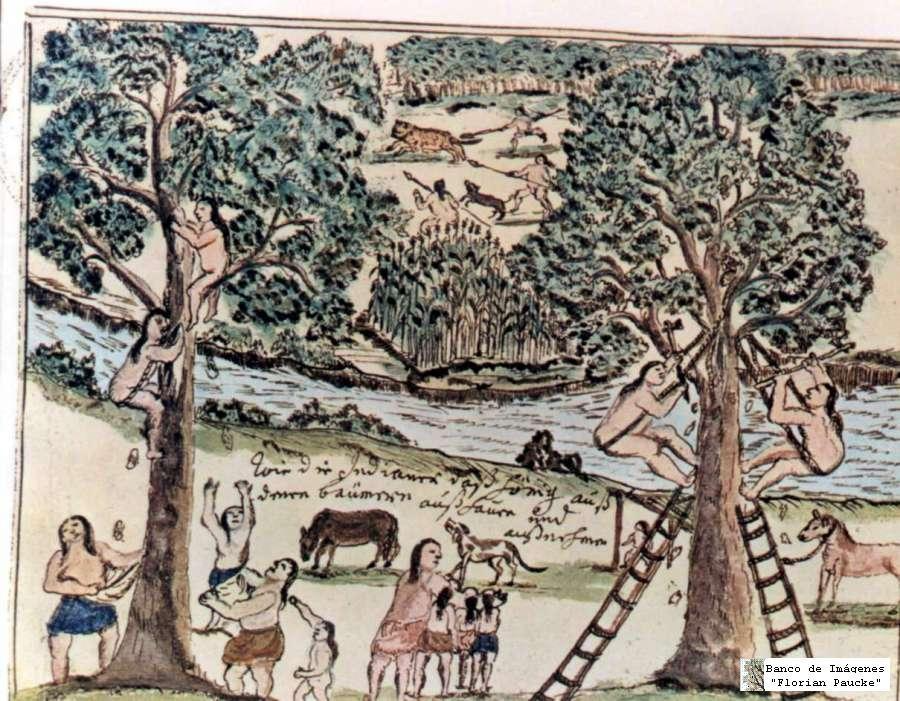
“Indigenous peoples of the Americas extract honey from the trees”
Florian Paucke Hacia acá y hacia allá, Santa Fe,
Ministerio de Innovación y Cultura, 2010, p. 118.
Notwithstanding this fact, the historiographical context offers contributions from disparate lines of research that contribute, either directly or tangentially, to reflection from promising and necessary angles, including economic history, the history of law and the social history of justice, in addition to social history, amongst others. It is evident that these approaches encompass both human agents and natural assets engaged in economic processes, in addition to the legal transformations that accompany the recognition of novel subjects of rights and the prevailing climate of ecological justice.
It is evident that a number of the contributions in this OJEO proffer contemporary interpretations that encourage us to interrogate the historical underpinnings of contemporary issues, including the case of the Paraná Delta. This space, categorized as a ‘wetland’ since the late 20th century, offers a valuable laboratory for historical analysis. It is particularly interesting to consider the following aspects: firstly, the islands’ territorial and symbolic identification as the ‘Paraná Delta’ in the mid-19th century; secondly, the landscape’s occupation by different generations of ‘islanders’, with different types of property rights established on these lands and waters; thirdly, the exploitation and commercialization of natural goods (animals, wood, fruit trees), with authorities in charge of their government and administration; and finally, the building of affective ties with the territory. A variety of archival and documentary sources, encompassing literary, cartographic, and official materials (including those from the Cabildo, censuses, official registers, and the cadastral, among others), stand as a testament to the capacity to confront contemporary challenges by drawing upon their historical depth and identity.
Further readings and resources:
Fontana, J. (1992): La historia después del fin de la historia. Reflexiones acerca de la situación actual de la ciencia histórica, Barcelona, Crítica.
Gallini, S. (2009): “Historia, ambiente, política: el camino de la historia ambiental en América Latina”. Nómadas (Col), N° 30, pp. 92-102.
Leff. E. (2004): “Vertientes y vetas de la historia ambiental: una nota metodológica y epistemológica”; “Problemas de métodos en la historia ambiental de América Latina”, en Anuario IEHS, 19.
Piazzi, C. (2019): “Una historia del derecho y de la justicia que se ‘tiñen de verde’: notas sobre un plan de investigación”, Estudios Sociales del Estado, Vol. 5, Nº 10.
Piazzi, C. (2024) “Aproximaciones para el diálogo entre Historia y Ambiente en la historiografía argentina”. Autoctonía. Revista de Ciencias Sociales e Historia, Vol. VIII, Nº2, Julio-Diciembre.