
The Role of Women in Agricultural Transitions
Marina A. Martinez, UNL
2026
The global food regime is incapable of guaranteeing nutrition to all humanity and doesn’t
even seem to have that objective in mind, even though there is enough agricultural
production to feed everyone. In this context, productive transitions that prioritize and
recover the knowledge of alternative agriculture are necessary. An agroecological transition
is a complex, multi-scalar process that varies with each territory, shaped by social,
economic, technological, cultural, political, ecological and gender factors. Within these
processes, women play a crucial yet often unrecognized role in food production,
biodiversity conservation, seed preservation and agroecological knowledge as a whole.
The capitalist, liberal economy and political system reinforce conventional logics of
production and are an obstacle towards adopting more sustainable models. Consequently,
the implementation of sustainable techniques are constrained by structural barriers, such as
land ownership, tenancy arrangements, climate conditions, or the availability of services,
among others. Small-scale producers often lack the necessary margin to assume the “risks”
associated with its implementation. As a result, these transition processes are marked by
contradictions, setbacks, and challenges.
To analyze the possibilities of a transition process, it is essential to contextualize
experiences and how agroecosystems function, considering three key criteria: (1) its
internal structural characteristics, (2) the specificities of the producer or family responsible
for the decision-making and system management, and (3) the external factors that condition
how the process develops.
An agroecological transition seeks to overcome these limitations by fostering sustainable
practices that recover local knowledge, promote productive diversification, and reduce
negative environmental and social impacts. Rather than relying exclusively on
technological innovation, it emphasizes a systemic transformation that is grounded in a
specific territory and its social relations.
The role of women is vital if we place care and the sustainability of life at the center of the
discussion. Throughout history, women have played a fundamental role in food production
and in the transmission of ancestral knowledge—a strategic function linked to the sexual
division of labor—, driving forward alternative models of agriculture and further extending
their contribution beyond the domestic sphere. In many places throughout history,
production subsistence has largely depended on them. Women have maintained
productivity on communal lands, organized collective life, defended their land and worked
towards the survival of their families and communities. When natural resources are
degraded or threatened, organized groups of women are often at the frontlines, being the
protagonists of many of the practices associated with what has been called the
“environmentalism of the poor”.
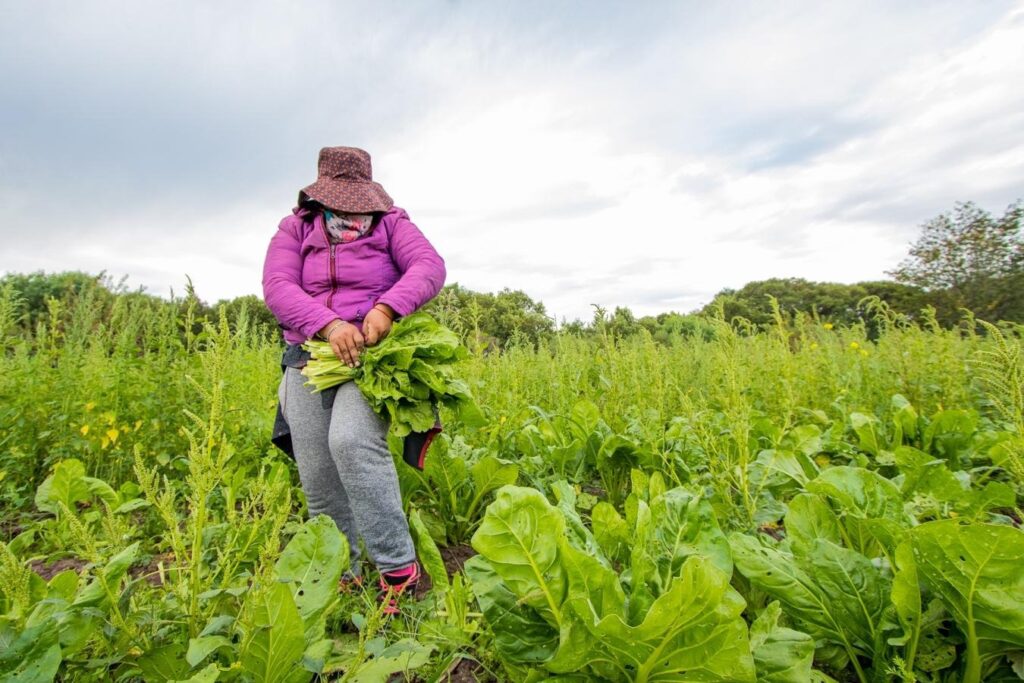
Title: Women land workers engaged in agroecological production at “La Verdecita” farm. Author: Bernardo Gaitán Otarán | CC-BY-SA-4.0
From a perspective of ecological justice, women’s centrality in agroecological transitions reveals alternative ways of organizing socio-ecological relations. By placing care, interdependence and the reproduction of life at the core of production systems, women’s practices challenge dominant extractivist logics that treat nature as a mere resource.
In the Global South, and particularly in Latin America, ecofeminism has addressed the intersection between gender and alternative agriculture—especially agroecology—and has emerged as a response to conflicts derived from extractivist models in agricultural sectors as well as in the use of agrochemicals.
In this sense, ecofeminism contributes a valuable framework for analyzing experiences of agricultural transition, as it allows us to understand the effects of the use of agrochemicals not only as an environmental problem but also as a factor that deepens gender inequalities. This issue particularly affects Latin American countries because it impacts consumption, health and safety as well as the well being of individuals and families. This only intensifies women’s burden within the sexual division of labor in what has been termed as the “feminization of survival” or the feminization of responsibility and obligation. Women’s role becomes even more visible when creating strategies for sustainable alternatives that ensure the survival of their families in territories dedicated to food production.
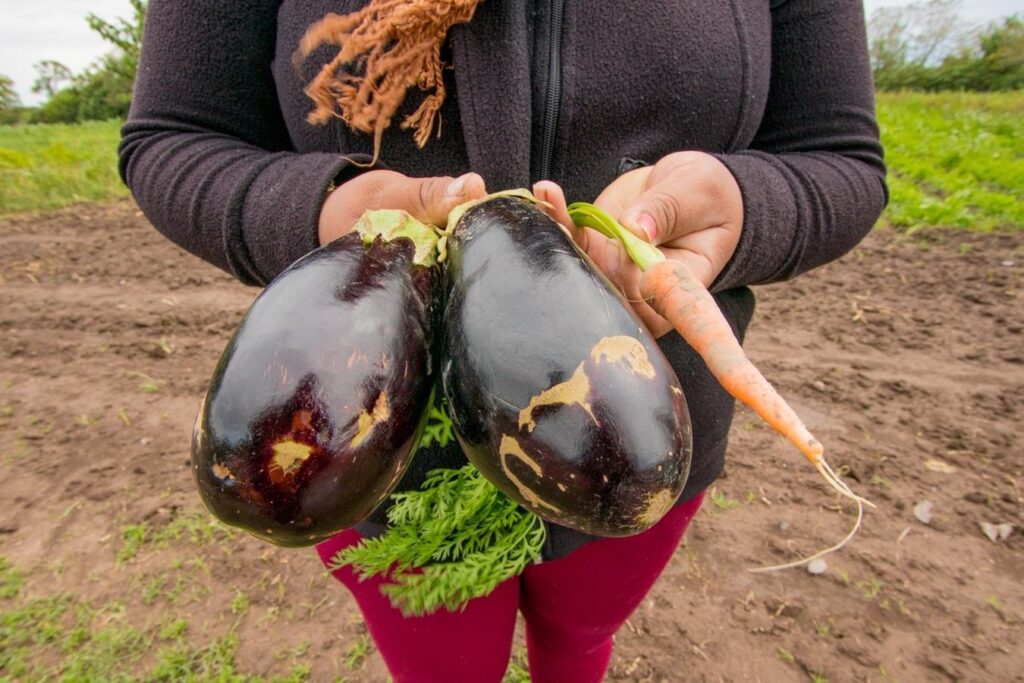
Title: Women land workers engaged in agroecological production at “La Verdecita” farm. Author: Bernardo Gaitán Otarán | CC-BY-SA-4.0
The parallels between the environmental crisis and the crisis of care are striking: both are the result of the same pattern of transgression of limits. The latter considers the time limits in caretaking and the former, the limits of the resources the Earth can provide. Both externalize the undesirable effects to distant territories—ecological debt in one case, global care chains in the other. Both crises are closely connected because they emerge within a culture that disregards these limits and ultimately turns its back on the care of life itself.
Bibliography
- Altieri, M. y Toledo, V. (2010) La revolución agroecológica de América Latina: Rescatar la naturaleza,asegurar la soberanía alimentaria y empoderar al campesino. El Otro Derecho. (42). 163 -202
- Craviotti, C. (2014). Agricultura familiar-Agronegocios: Disputas, interrelaciones y proyectos. Territorios, 16(30), 17-38.
- Herrero, Y., Cembranos, F., & Pascual Rodríguez, M. (Eds.). (2011). Cambiar las gafas para mirar el mundo: Una nueva cultura de la sostenibilidad (1a ed). Libros en Acción.
- López-García, Daniel (2023) Transición ecosocial y mundo agrario. Brechas, puentes y horizontes comunes. Pensamiento al margen. Revista Digital de Ideas Políticas. (18) 112-132.
- Svampa, M. (2023) Dilemas de la transición ecosocial desde América Latina. En G. García Parra y K, Batthyány (et. al.) Transiciones justas. Una agenda de cambios para América Latina y el Caribe. CLACSO: Ciudad Autónoma de Buenos Aires. 35-87