Civil Liability for Climate Change: The Lliuya v. RWE AG Ruling
Antonio Pulgar Martínez, ONG FIMA
Sofía Rivera Berkhoff, ONG FIMA
2026
As we already argued in a previous post (link), in strategic litigation, there are objectives that are fulfilled regardless of whether the particular case is won or lost. This is what happened in the case “Lliuya v. RWE AG,” in which the ruling of May 28, 2025 dismissed Saúl Luciano Lliuya’s claim against the energy company RWE, yet its content constitutes a significant advance in the matter of liability for climate harms. This is one of the cases of what we call: inhabiting the boundaries of law.
Indeed, even though the court did not rule in Lliuya’s favor for procedural reasons, in substance it declared that major emitters of greenhouse gases can be held responsible for climate harms worldwide—a point recognized for the first time by a higher European court. Through this recognition, as this post will show, the possibilities of modern law are put under tension by using its own tools.
The Lliuya v. RWE AG Case: Winning by Losing
In 2017, Saúl Luciano Lliuya, a Peruvian farmer and mountain guide, made a radical decision: to sue a private company over the risk of his town’s disappearance. Seeing that the glacial lake located on the mountain above his town was increasing in volume due to the melting of the Andean glaciers, Lliuya determined that he had to act to avert that risk or, if it proved unavoidable, to obtain compensation. Thus, with the help of a German legal team, they decided to take the risky but strategic action of suing the German company RWE AG for its contribution to climate change, which would generate the risk faced by Lliuya’s town.
The claim filed requests that:
“It be determined that the defendant is responsible for covering, in accordance with its proportional share of responsibility for the harm, 0.47% of the costs resulting from the implementation of appropriate protective measures by the claimant or by third parties to protect the claimant’s property from flooding caused by the melting of the glacier and the overflow of Lake Palcacocha, insofar as the claimant has to bear these costs”. The claim can be reviewed here (link)
On May 28, 2025, the Higher Regional Court of Hamm (the court of second instance) issued its ruling in the case, dismissing Lliuya’s claim on the grounds of insufficient evidence. Nevertheless, this ruling recognized, at the same time, that the legal basis (the German Civil Code) is applicable to the specific case. As a result, absent the procedural obstacles, the case could have given rise to the company’s civil liability for its contribution to climate change.
Palcacocha glacial lake surrounded by the Pucaranra and Palcaraju glaciers. Photo: Alexander Luna / Germanwatch e.V.
Legal Innovation Through a Traditional Legal Provision
How did the Court reach this conviction? The basis of the discussion in the case was the action under Article §1004 of the German Civil Code (BGB). According to this provision, there is liability on the part of anyone who interferes with another’s property, in what has been called neighbour litigation for property harm:
§1004 Para. 1: If the ownership right is interfered with in any way other than the dispossession or withholding of possession, the owner may demand that the person causing the interference cease it. If further interferences are to be feared, the owner may request the adoption of injunctive measures.
The reasoning of the Hamm Court in this case was that climate change, with its transboundary effects, has given rise to a kind of global relationship of neighbourhood, so that Article 1004 also applies in this case. In doing so, it builds a highly relevant legal innovation: “the possibility of establishing the direct non-contractual civil liability of a company for the adverse effects of global climate change suffered by a person abroad” (Costa, 2025). But it also brings critical socioeconomic aspects into the focus of discussion: the distribution of burdens and benefits between the global North and South, and private-corporate responsibility for climate change (Costa, 2025).
In this case, it is the modern legal system itself—specifically the branch of civil law—that presents obstacles and tensions in applying the traditional system of damages to the environmental harms arising from climate change (Costa, 2025). The Lliuya case is a representation of how, through strategic litigation, one can inhabit that tension within the law, generating legal innovations that enable other communities to resolve socio-environmental conflicts, along with reinterpretations of the law’s traditional institutions to address the complexity of the climate and environmental crisis.
Does Innovation Require Importing? The Value of Innovating from Within the Legal Tradition
The Lliuya case offers us further insights that go beyond the recognition of major emitters’ liability; it also shows us the value of the path chosen to arrive at that recognition. Along that path, Lliuya’s defence did not resort to a legal category that was new or foreign to the system, but rather managed to have the Court reinterpret a traditional provision of civil law so as to make it operate in the face of a phenomenon its original wording never contemplated. Herein lies, precisely, the strategy: rather than importing or implementing ideas that do not respond to the legal tradition in which they are discussed, this strategic litigation sought innovations that rest upon the system’s own institutions. An innovation built from within the system has a different kind of force, because it does not depend on the court renouncing its conceptual framework, but on it carrying that framework to its own limits.
It is at this point that the proposal we developed in our previous post (link) takes on its full meaning: that of inhabiting the boundaries of law. Inhabiting the boundary does not mean abandoning the instruments of modern law, but appropriating them from the perspective of those who have been left out of its consideration—the communities and ecosystems of the global South—renegotiating from within the process by which the boundary is incorporated into the logic of the system. The Lliuya case is a clear example of this exercise: it is the formal tools of civil law that are employed, but in the service of a transformation that the system itself tends to resist. The strategy does not consist in breaking the traditional framework, but in placing it under tension from within, showing that its categories can account for conflicts that exceed the horizon for which they were conceived. Herein lies the ultimate meaning of inhabiting the boundaries of law: not in replacing the rules of civil law with something else, but in demonstrating that its own rules, read in the material context of globalization and of the climate crisis, can become concrete pathways for the communities that inhabit the boundary to confront socio-environmental conflicts of planetary scale.
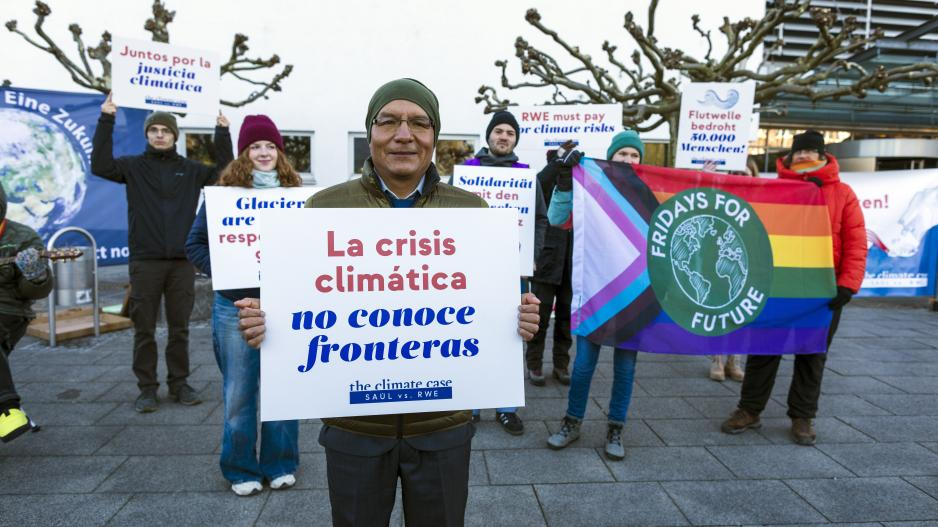
Saúl Luciano Lliuya with supporters outside the Higher Regional Court of Hamm. Photo: Alexander Luna / Germanwatch e.V.
References:
Costa, Ezio (2025). “Daños de la crisis climática y responsabilidad transnacional de las empresas de combustibles fósiles: comentario de la sentencia Lliuya vs. RWE AG.” Revista Derecho, Ambiente y Cambio Climático, No. 1.