
Between Rearrangements and Dependencies: the Agroecosystems of the Axarquía (Spain)
Andreas Jünger, Rachel Carson Center (LMU)
2026
Agroecosystems are socio-ecosystems—”complex assemblages of biotic, abiotic, and human communities” characterized by deliberate anthropogenic reorganization for production, or as historian Donald Worster has aptly described them: “domesticated ecosystem[s].” In Europe, this domestication is exemplified by the 30,000-hectare intensive greenhouse concentration near the Andalusian city of Almería (Spain). While this “sea of plastic” highlights systemic socio-ecological injustices, the broader Andalusian context demonstrates that justice measures must transcend such emblematic cases. Given the region’s diverse geo-climatic conditions and varying local developments, socio-ecological justice requires site-specific frameworks rather than “one-size-fits-all” approaches to address the unique fault lines of individual agroecosystems. While the intensive production around Almería dates back to the 1960s, other Andalusian agroecosystems highlight the sometimes centuries-old historical development of anthropogenic rearrangements for food production.
Agriculture in the Axarquía from the Middle Ages to the Early 20th Century
One such example is the Axarquía, a geographically diverse region east of the city of Málaga that spans more than 1,000 km² from the Mediterranean coast to the summit of La Maroma, which rises over 2,000 meters, and is characterized by an exceptionally mild climate with over 300 days of sunshine per year. At the same time, the steep and hilly terrain creates numerous microclimates.
Although inhabited since antiquity, the Axarquía’s agricultural intensification was significantly developed further during the Nasrid Kingdom (13th–15th centuries). This period exemplifies Worster’s dual criteria for agroecosystems: the creation of a “truncated natural system” and the establishment of a “system of export.” Nasrid agriculture integrated advanced hydraulic engineering, terracing, intercropping, and crop rotation to ensure regional food security and the political survival of the Muslim state. Cultivation followed a distinct spatial logic: irrigated coastal zones supported sugarcane and mulberry (for silk production), while legumes were managed via dry farming, and viticulture occupied steeper, marginal terrains. These specialized outputs—primarily silk, sugarcane, and dried fruits—integrated the region into high-value international trade networks.
After the so-called “Reconquista” of the Iberian Peninsula by the Castilian troops was completed with the surrender of Granada (1491), the new rulers pushed for agrarian transformation, including a shift toward more monocultures and large-scale dry farming. However, in many places, these plans were difficult to implement due to natural conditions. This was also the case in the mountainous regions of the Axarquía, where grapevines increasingly dominated the landscape. By the early 17th century, viticulture and the trade in its products had become a central pillar of the economy of the Málaga region.
In the 19th century, the increasing globalization of agricultural trade had a negative economic impact on the structurally small wineries of the Axarquía. Yet even more than dependence on the economic variables of international markets, the arrival of new non-human actors revealed the ecodependence of agroecosystems: the phylloxera (Viteus vitifoliae) plague, initially introduced undetected from the United States, spread from the village of Moclinejo throughout the entire Axarquía and subsequently to large parts of Spain’s wine-growing regions. The resulting drastic decline in viticulture—in the province of Málaga from over 110,000 hectares of vineyards in the 1870s to 25,000 hectares at the beginning of the 20th century —led to the abandonment of numerous small farms and the emigration of entire families, while the remaining production shifted its focus more toward table grapes and raisins and reoriented itself toward substitute crops such as almonds and olives. The remaining vineyards now consisted mostly of resistant American rootstocks and were cultivated more intensively as monocultures, whereas before the phylloxera infestation, about half of the vineyards had been planted in mixed cultivation with olive or fruit trees.
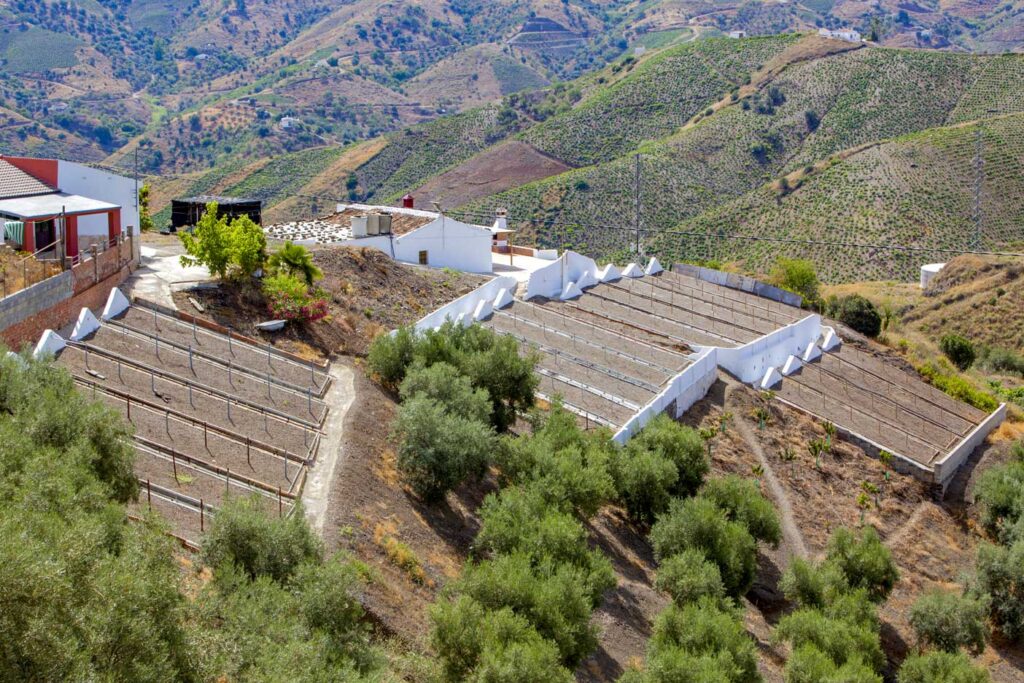
Traditional raisin-producing landscape with its characteristic paseros (raisin drying beds) in El Borge; Courtesy of Ayuntamiento de El Borge (rutavinorondamalaga.com).
On the way to the Tropiterranean
After the Spanish Civil War (1936–39), the agricultural structure of the Axarquía was initially characterized by small-scale subsistence farming. In addition to raisin production, cereals and legumes dominated, sometimes integrated with tree crops such as almond, olive, citrus, and carob trees. Starting in the 1960s, Spain’s coastal tourism boom triggered an exodus of many rural residents of the Axarquía to the service and construction sectors. While sugarcane cultivation disappeared entirely, vineyard areas also shrank dramatically from over 13,000 hectares in 1978 to under 3,000 hectares by 2018.
Meanwhile, starting in the 1970s, the cultivation of subtropical fruits expanded (initially mainly avocados and cherimoyas, later also mangoes) thanks to new irrigation infrastructures, particularly the “La Viñuela” reservoir (1989). This allowed production to extend from the coast to higher elevations. In 2021, the region produced 117,000 tons of avocados and 41,000 tons of mangoes, accounting for over 80% of European production and primarily intended for export.
What serves as a competitive product for growers to survive leads to ecological problems, some of them severe, due to the plantations that have been established. As Worster has already emphasized, agroecosystems represent “a rearrangement, not a repeal, of natural processes.” Notable problems include the enormous water demand, which has already been partially met through illegal irrigation, while water-saving effects have been negated by the rebound effect resulting from land expansion. Combined with periods of drought (lastly 2019–2024) and plantations on erosion-prone slopes, the risk of desertification and the loss of biodiversity in these agroecosystems increase significantly.
A Way Forward: Tradition and Degrowth
It was the drought during the 2022/23 harvest season in particular that marked a turning point: massive crop failures for mangoes (80%) and avocados (50%), the death of numerous trees, and the critical depletion of water resources pushed the region to the brink of ecological collapse. Even grapes, which are significantly better adapted to dry conditions, suffered heavy losses at that time. Nevertheless, the FAO’s recognition of raisin production as a Globally Important Agricultural Heritage System (GIAHS) just a few years earlier had underscored its high agro-cultural value as well as its essential role in erosion control and the preservation of regional biodiversity. Despite these ecological benefits, fragile markets and climatic volatility limit the resilience of this agroecosystem, which is therefore not a panacea in and of itself.
Positive developments in the subtropical fruit sector include an increasing focus on agroecological and regenerative practices as well as innovative direct-to-consumer channels that aim for more sustainable market integration. However, a politically driven degrowth strategy is indispensable for the long-term stabilization of the Axarquía. This must include a targeted reduction in subtropical plantation areas as well as a transition from an efficiency to a sufficiency paradigm in order to sustainably ensure the well-being of human actors and the non-human world.
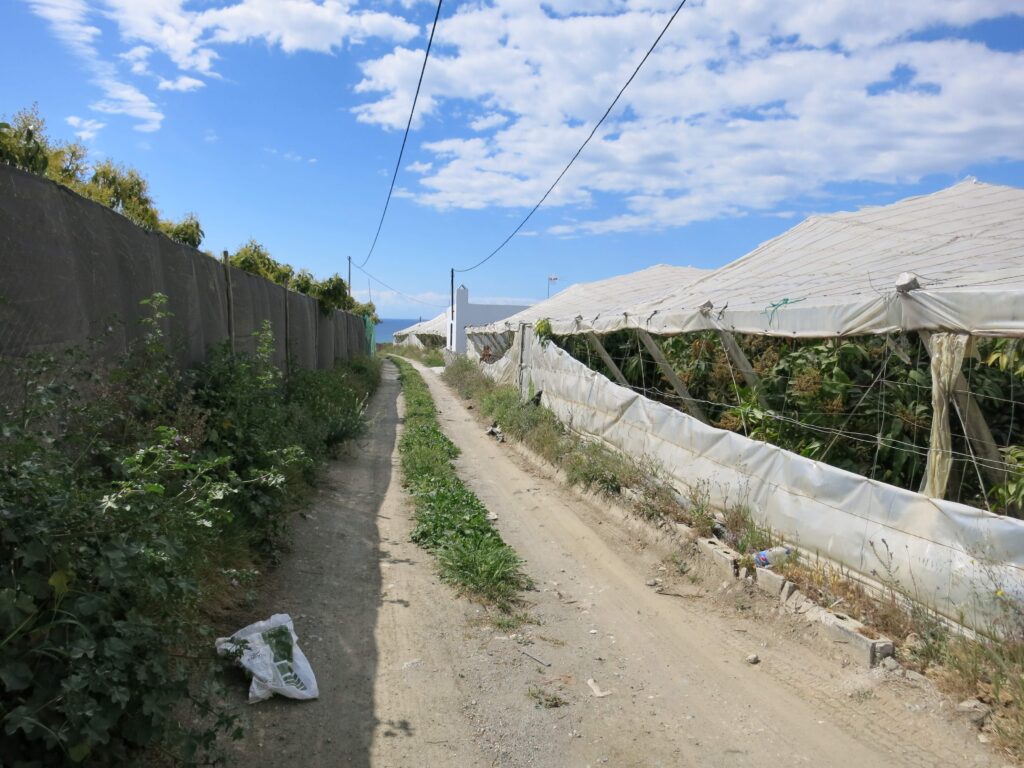
Avocado (left) and mango (right, under plastic) grown on the coast near Nerja; Photo: Andreas Jünger.
Further readings and resources:
Worster, Donald. „Transformations of the Earth.“ In The Wealth of Nature: Environmental History and the Ecological Imagination, 45–63. New York: Oxford University Press, 1993.
Fábregas, Adela. “The Nasrid Economy.” In The Nasrid Kingdom of Granada between East and West: (Thirteenth to Fifteenth Centuries), edited by Adela Fábregas, 155–76. Leiden: Brill, 2021.
Pérez Hidalgo, Francisco Manuel. „El vino de Málaga tras la plaga de la filoxera. La crisis y los problemas de la replantación.“ Aportes: Revista de Historia Contemporánea 37, no. 110 (2022): 103–34.
Food and Agriculture Organization of the United Nations (FAO). Sistema Productivo de la Uva Pasa de Málaga en La Axarquía. España. Rom: FAO, 2017.
Junquera, Victoria, José I. Hormaza, Daniel I. Rubenstein, Simon A. Levin, Iñaki Vadillo Pérez and Pablo Jiménez Gavilán. „Severe Water Crisis in Southern Spain under Expanding Irrigated Agriculture: A Multidimensional Drought Analysis.“ Proceedings of the National Academy of Sciences 122, no. 39 (2025): e2508055122. https://doi.org/10.1073/pnas.2508055122.
Justicia Alimentaria. El mango que manga: Una investigación del Observatorio de Corporaciones Alimentarias (OCA). Barcelona: Justicia Alimentaria, 2023. .