Innovative University Teaching as a Tool for Promoting Environmental Law and Ecological Awareness
Stefano Rossa, UPO
2026
The challenges that sustainable development (and environmental protection more broadly) pose to public institutions are profoundly significant, impacting the supranational perspective while reverberating across an intertemporal dimension.
Consequently, it is remarkably difficult, at least from a legal standpoint, to devise effective instruments for the implementation of international environmental policies. This is particularly true when considering the “glocal” perspective (i.d. “Think globally, act locally”) established as early as the “Agenda 21” of the United Nations Conference on Environment and Development in Rio de Janeiro (1992).
To this purpose, public institutions are required to adopt an approach of continuous adjustment and refinement of the tools they develop and implement over time, in line with the logic of the periodic meetings of the Conference of the Parties (COP).
Similarly, this need to “fine-tune” one’s approach to align with evolving social and environmental sensitivities is also evident in the university teaching – especially that of environmental law. For some years now, academia has strongly questioned the use of the traditional, lecture-based method as the primary teaching methodology, highlighting the need to integrate it with new educational approaches.
Indeed, in an increasingly complex world and a society where issues are inextricably linked, universities are no longer expected merely to transmit theoretical knowledge; rather, they must equip students with practical expertise.
It is therefore essential to complement the passive (but still indispensable) aspect of teaching with an active dimension. Through this, learners interact with the issues under analysis from various perspectives, taking the lead in understanding challenges and seeking concrete solutions. Environmental law proves to be an excellent field of practice for this type of innovative, laboratory-style teaching.
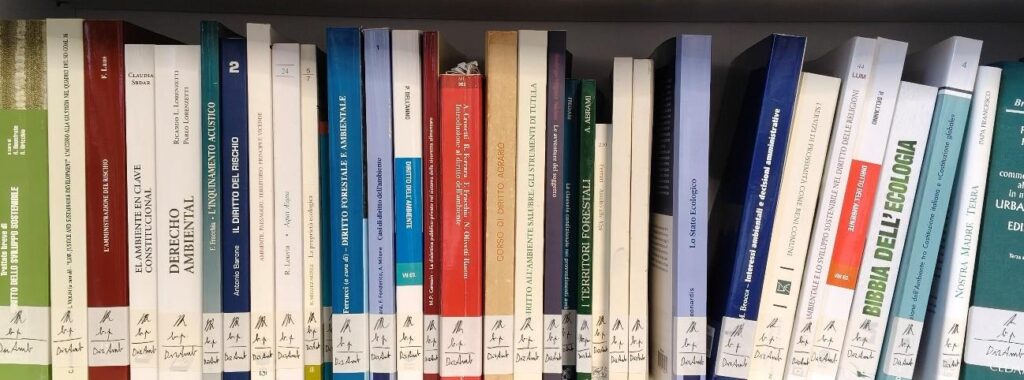
Ph. Stefano Rossa
One example involves presenting a specific problem to the audience, providing a theoretical foundation, and initiating a discussion among students to highlight the criticisms and advantages of different potential solutions. Myself, for instance, experienced how a lecture originally designed as a standard presentation (titled “El derecho ambiental y sus fundamentos jurídico-filosóficos”) evolved in itinere into a guided discussion. This took place on 21 August 2025 during my Speak4Nature Secondment period at the Universidad Nacional del Litoral, Santa Fe, Argentina (Facultad de Ciencias Jurìdica y Sociales) within the Curso de Derecho ambiental of Professors P. Sánchez Izquierdo and L. Gottardi. The discussion explored how legal-philosophical concepts have shaped environmental history and the legal framework for environmental protection. This dialogue was conducted according to the Socratic method and focused, for example, on the forest and differing waste recycling regimes between Italy and Argentina.
Another example of innovative teaching is the “moot court” model: a well-known mock trial that allows students to engage directly with the most complex legal issues by assuming the role of a party in proceedings and following the rules of a genuine, albeit simulated, trial. This experience was organised at the University of Eastern Piedmont (UPO) as part of the Free Mover project “D&SIGN: Law and Sustainability: An Integrated Approach to Environmental Management”. This UPO initiative enabled several students from the Italian university to be hosted at the Rachel Carson Center (RCC) for Environment and Society at Ludwig-Maximilians-Universität in Munich, thanks in part to the fruitful collaboration established within the Speak4Nature project itself, given that both UPO and RCC are members of it. There, teams of students from both universities engaged in a mock trial, specifically adapted and supplemented with role-playing elements, based on a landmark case from the European Court of Human Rights regarding international environmental law and climate litigation.
The two cases outlined above are just a few among many examples of innovative teaching methodologies. Nevertheless, they testify to how this form of instruction, particularly when applied to environmental and sustainable development law, can serve as a powerful tool for promoting ecological culture. Through experiential learning, this culture is “brought to life” for students, moving beyond the limitations of mere ex cathedra lessons.
Further readings about this topic:
- Oddenino, S. Quattroccolo (2025), ‘Meaning and Values of Teaching Law in a Global Perspective’, Ars Interpretandi, n. 2, p. 11 ff.;
- M. Vogliotti (2025), ‘Implicazioni della connessione tra atto e norma: “case method” e immaginazione nella formazione giuridica’, Ars Interpretandi, n. 2, p. 27 ff.;
- R. Lombardi (2023), ‘Passeggiate (di una amministrativista) nei boschi narrativi della scienza giuridica: alla ricerca del metodo didattico e del linguaggio’, in M. Andreis, G. Crepaldi, S. Foà, R. Morzenti Pellegrini, M. Ricciardo Calderano (a cura di), Studi in onore di Carlo Emanuele Gallo, Vol. I, Giappichelli, Torino, p. 103 ff.;
- N. Nikonova (2020), ‘Application of interactive and innovative forms and methods in legal Disciplines Teaching’, Universidad Y Sociedad, 12(2), p. 212 ff.;
- M. Vogliotti (2016), ‘Pour une formation juridique interdisciplinaire’, in J.J. Suer, S. Farhi (dir.), Pratique(s) et einsegnement du droit. L’épreuve du réel, LGDJ, Paris, p. 277 ff.;
- V. Cerulli Irelli, O. Roselli (2000) (a cura di), Per una riflessione sulla didattica del diritto: con particolare riferimento al diritto pubblico, Franco Angeli, Milano.